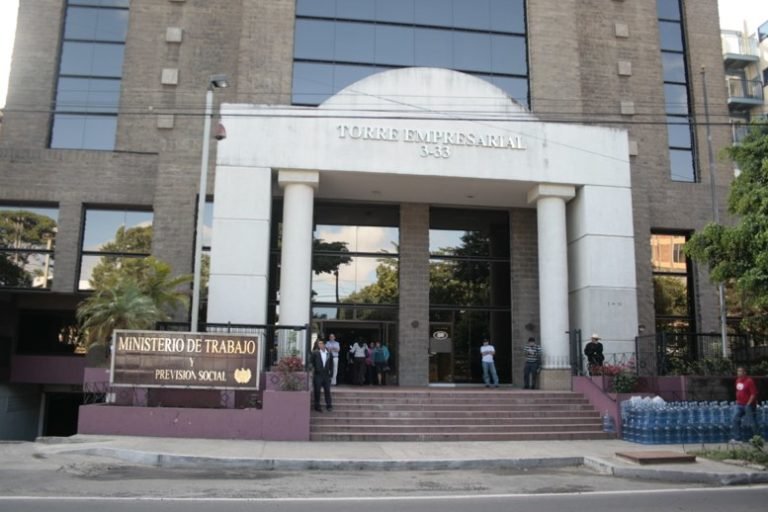

The General Labor Inspectorate is a department of the Ministry of Labor and Social Welfare responsible for verifying compliance with labor, social security, and occupational health and safety regulations in workplaces.
For companies, this means that labor compliance should not be viewed solely as a formal obligation. Today, it represents a real economic risk, because an inspection can result in fines, corrective orders, administrative proceedings, and even legal actions if the employer does not adequately address the labor authority's requirements.
In Guatemala, many companies still assume that the main labor risk comes solely from a lawsuit filed by an employee. That view is incomplete. In addition to labor lawsuits, there are also contingencies arising from inspections, summons, and sanctioning proceedings initiated by the General Labor Inspectorate.
Table of Contents
- 1 What can the General Labor Inspectorate review?
- 2 Powers of labor inspectors
- 3 What are the sanctions of the General Labor Inspectorate?
- 4 Examples of non-compliance that can result in sanctions
- 5 The penalty does not eliminate the obligation to correct.
- 6 Can the employer defend themselves?
- 7 Sanctions can also affect contracts with the government.
- 8 Prevention is cheaper than punishment.
- 9 What should a company do before an inspection?
- 10 Conclusion
What can the General Labor Inspectorate review?
The General Labor Inspectorate can verify if a company is complying with its basic labor obligations. This includes, but is not limited to, individual employment contracts, payment of wages and benefits, working hours, rest periods, payroll books, Internal Work Regulations, occupational health and safety measures, registration of committees when applicable, labor documentation, and compliance with employer obligations.
The inspection can originate from a complaint by a worker, from an institutional schedule of the Ministry of Labor, or from a specific situation that requires review by the authority. The visit can be carried out directly at the workplace or by summons requiring the employer to appear and present documents.
The critical point is that the company must be prepared before receiving a subpoena or a visit. Trying to organize contracts, books, regulations, employment files, or occupational health and safety documentation once an inspection already exists can be too late.
Powers of labor inspectors
Labor inspectors have the authority to enter workplaces during working hours, request information, interview workers, ask for documents, verify working conditions, and record the facts through official reports.
The employer has the obligation to cooperate with the inspection. This entails responding to the authority, providing the required information, allowing the corresponding verification, and appearing when summoned. Unjustified refusal, obstruction, or lack of cooperation may lead to an independent sanctioning procedure for obstructing inspection work.
This point is important because many companies make a serious mistake: they react defensively, prevent entry, fail to deliver documents, or do not appear for summons. This attitude can aggravate the problem. Defending yourself does not mean obstructing. Defending yourself correctly means collaborating, documenting, presenting arguments, and using available legal resources within the corresponding timeframe.
What are the sanctions of the General Labor Inspectorate?
The labor sanctioning regime in Guatemala was strengthened through reforms to the Labor Code. Currently, fines can be calculated based on current monthly minimum wages for non-agricultural activities, depending on the type of infraction.
This converts sanctions into progressive fines, because they increase to the extent that the minimum wage increases each year.
For example, in accordance with the current monthly minimum wage for non-agricultural work in Guatemala department for 2026, a fine of 18 minimum wages can exceed Q72,000.00, without taking into account possible interest, recidivism, accumulation of infractions, or the additional obligation to correct the offense.
The Labor Code provides for different penalty ranges. Violations related to the payment of wages and labor benefits can result in fines of 8 to 18 non-agricultural monthly minimum wages. Violations in occupational health and safety matters can generate fines of 8 to 16 non-agricultural monthly minimum wages. Other violations of labor provisions can result in fines of 2 to 10, 6 to 12, or 2 to 9 minimum wages, depending on the nature of the unfulfilled obligation.
This means that a company doesn't necessarily face a single fine. If multiple violations are found during an inspection, there can be several contingencies at the same time. For example, not having updated individual contracts, not having Internal Work Regulations when required, not properly keeping salary books, or not complying with occupational health and safety obligations can generate a scenario of accumulated risk.
Examples of non-compliance that can result in sanctions
Among the most common breaches that can lead to observations, warnings, or sanctions are not having properly documented individual employment contracts, not having Internal Work Regulations when required by law, not keeping payroll books, not correctly paying labor benefits, not respecting working hours and rest periods, not documenting vacations, not having minimum occupational health and safety measures, or not responding to summons from the General Labor Inspectorate.
Risks can also arise when a company does not have complete employment records. An employment record should not be limited to the contract. It should contain basic documentation of the employment relationship, payment records, vacations, leaves of absence, disciplinary actions, relevant communications, job changes, salary modifications, and any other document that allows for the verification of employer compliance.
In labor matters, what is not documented often becomes a proof problem for the employer.
The penalty does not eliminate the obligation to correct.
A common mistake is thinking that paying the fine resolves the problem. Not necessarily.
The disciplinary procedure is not solely intended to impose a fine. It also aims to correct the non-compliance. Therefore, even if the company pays a penalty, it may still be obligated to remedy the violation that initiated the procedure.
This has an important practical consequence: the company should not focus its defense solely on reducing or disputing the amount of the fine. It should also review what obligation it is being required to comply with, whether the prevention is legally valid, whether the given deadline is reasonable, and whether there are sufficient documents to prove compliance.
Can the employer defend themselves?
Yes. The employer has the right to defense within the administrative procedure and, depending on the case, may also resort to the appropriate judicial channels.
However, the defense must be exercised within the established deadlines. If the company receives a notification and does not act in a timely manner, the resolution may become final. Once final, the fine can be collected, and the authority can take appropriate action to demand compliance with the resolution.
Therefore, in the face of a notification from the General Labor Inspectorate, the worst thing a company can do is ignore it. The reaction must be immediate: review the file, identify the infraction indicated, gather documents, analyze whether there has been compliance, prepare arguments, and submit the appropriate appeals or responses.
Not every penalty is correct. There can be errors in the classification of the offense, lack of proportionality, procedural non-compliance, documents not considered, or facts that do not correspond to the company's reality. But if the defense is not presented correctly, those arguments can be lost.
Sanctions can also affect contracts with the government.
One aspect that many companies overlook is that labor sanctions can have effects beyond paying a fine. The existence of pending sanctions and the failure to correct labor violations can affect the ability to obtain or maintain certain benefits, participate in bids, quotes, or contract with the government.
This is especially relevant for companies that supply the government, construction companies, service companies, companies with tax benefits, or entities that depend on public procurement processes. In these cases, an administrative labor contingency can become a business obstacle.
Prevention is cheaper than punishment.
The best defense against the General Labor Inspectorate is preventive compliance.
A company should periodically review its labor documents, contracts, internal regulations, internal policies, work schedules, payments, employee records, occupational health and safety measures, and disciplinary procedures. This review should not only be done when a problem already exists but as part of the company's normal operations.
Workplace compliance should not be understood as bureaucracy. For a formal company, it is a way to reduce risks, avoid fines, prevent lawsuits, improve internal administration, and demonstrate seriousness to employees, clients, banks, investors, and authorities.
What should a company do before an inspection?
Every company should have, at a minimum, up-to-date individual employment contracts, organized employee files, payment records, vacation tracking, work hour logs, labor books when applicable, an Internal Work Regulation if applicable, disciplinary policies, occupational health and safety documentation, and evidence of compliance with labor benefits.
Furthermore, it is advisable for the company to clearly define who will attend to the inspectors, what documents can be provided, how to respond to a summons, and what internal procedure will be followed in case of receiving a warning or a potential sanction.
Improvising during an inspection is an unnecessary risk. The company must have a clear strategy and available documents.
Conclusion
Sanctions from the General Labor Inspectorate in Guatemala can represent a significant contingency for employers. These are not symbolic fines. Depending on the non-compliance, they can reach significant amounts and, in addition, force the company to correct the detected violation.
The risk increases because fines are calculated based on minimum wages, so their economic impact can grow year by year. It should also be taken into account that an inspection can detect several non-compliance issues at the same time, generating an accumulated contingency.
Therefore, companies must adopt a preventive approach to labor compliance. Having contracts, files, regulations, books, internal policies, and documentation in order not only serves to avoid penalties but also to defend oneself properly when there is an inspection by the labor authority.
In labor matters, internal disorder is usually expensive. Legal prevention, on the other hand, reduces risks, allows for better arguments, and protects the continuity of the company.